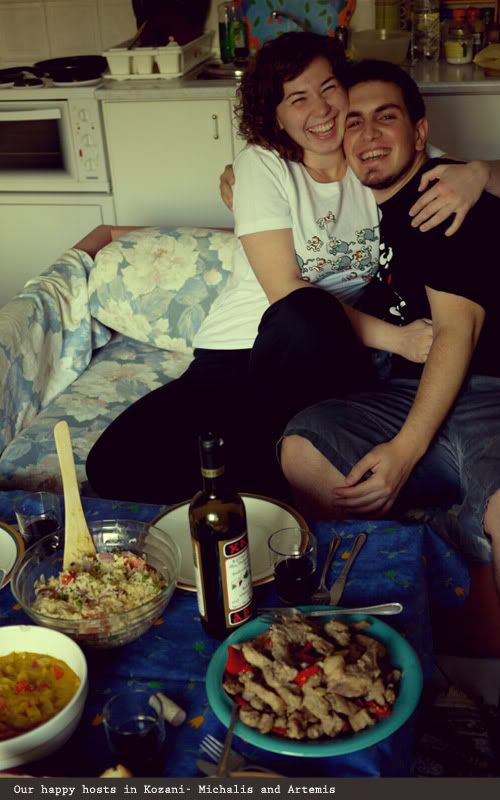
We didn't know much about Kozani except that it was home to coal-powered electrical plants with air heavy of smoke and the clothes you hang to dry end up covered with soot, and basically, it is nothing of real interest for any foreigner or local - as told by some of the Greeks we met. Now that isn't exactly the most inviting description for any place but anyway, we looked forward to meeting Michalis, our host, a mechanical engineering student.
Wednesday, September 22, 2010
Tuesday, September 21, 2010
Day 9: Holy Meteora!
"Did you expect it to be like this?", Fra often asks me this question whenever we go to a new place and although my answer is often no, because I hardly expect anything and prefer to be surprised than disappointed, I did have an expectation of Meteora and it wasn't met. Instead, it surpassed everything I could have conceived in my brain and it was so powerful that it hit straight through me and made my soul grow. Grow and grow and grow! Wait a minute, I have a soul? Its a miracle.


Monday, September 20, 2010
Day 8: Lamia and Thermopyles
Two different places in one day.
Lamia - progressive city, small streets, big appetite, home of Nikos Tsonis, politician of the socialist party who agreed to be interviewed and offered to host us for a night. After taking us for a walk around town and shaking the hands of almost anyone in the streets, we learned quickly the importance of community, or at least connections, in any system of power.
Thermopyles - with its receeding shoreline that vaguely reminded us of Sumeria and Mesopotamia, grand cities of antiquity now transformed into the desert land of Iraq, we began to ponder how it would be in several decades to a century. Back in 480BC in this same spot 300 men from Sparta fought with thousands (nay, a million! -according to the little history plaque on site) of Persians. Now, there are olives covering the hills among ruins of an acropolis that probably fell after centuries of erosion, earth quakes or just the decaying effect of time and forgetfulness. We went all the way to the top and marveled at the unusual land and water formations unique to Greece. Its still absolutely stunning.


Sunday, September 19, 2010
Day 7: Off the sea and back on the road again
4 days in Kythnos turned out to be much more than we expected. After the initial shock (met with a slight feeling of doom that can only be compared to being at the mercy of gods), we went in and flowed with the flow anyway. Foreigners don't often ponder their ignorance which, in our case, was exactly the case. However, this seemed to work out extra well as we went from adventure to surprise each and every single day. The landscape and its bare furnishings was clearly not the end of the story. All the people we met, the places we walked and swam to with its little nooks and corners, witnessing the light bounce off our cheeks and on the hills, changing colors and smelling different smells, tasting different tastes - just so many things have touched us, shaken us from not abiding to the law of "Do not Judge a book by its cover".
Experience like this makes you happy about being wrong sometimes. It makes surprises all the more surprising.
Saturday, September 18, 2010
Day 6: Fishing for Treasure
2 things happened today:


1.) Fishing with a fisherman.
2.) Swimming over an archeological site.
For now, I'll have pictures explain what words cannot.
Friday, September 17, 2010
Day 5: First Encounters
Day two in Kythnos, still no sign of the Professor despite the proximity (the owner of the room informed us that we were staying right beside his room), we decide to take a walk around the port. We meet Marios, a marine biologist assigned in Kythnos, who shares with us some of his experience with the local fishermen. There beside the fish and the old women sitting and waiting for the next fresh catch, we hope to learn some more about this difficult job. After an hour with the locals sitting, smoking, sipping on cups of coffee, Mario finally explains that they are camera-shy and only "the most beautiful" president of the fishermen's association of Kythnos could agree to do an interview. After a few exchanges in english-hellenic, Marios as our middle-man, they agreed to meet us again the following day, early in the morning to experience the first catch.
Sometime around 6pm in the afternoon at a cafe near the port, we finally meet the Professor. After a brief exchage of introductions we head off to Chora, a nearby town, where the makeshift office/workshop is the old municipal hall, soon to be transformed into the first museum of island. I get to experience first-hand the work of an archeologist - brushing debris off an ancient piece of pottery! It was thrilling and it was even more interesting to be hearing stories of the challenges involved in archeological work. After hearing from the Professor himself, we grew to appreciate this profession as something beyond Indiana Jones or The Mummy, archeology is also hard and determined work. Despite that, the only grafitti on the workshop wall says, "I love my school". and I think that says it all.
Thursday, September 16, 2010
Day 4: The Elusive Professor Mazarakis
It wasn't easy leaving Athens. One day without seeing the ancient ruins is like passing by Egypt without seeing the pyramids. Shame, shame.. But a certain Professor Mazarakis awaits us in Kythnos, an island we know nothing of, and this is enough for us to cross the sea and brave the unknown.
On board the ship we gather our materials, read some more of our printed bio on the Professor and his archeological work in Kythnos. Hes a well travelled man and has established himself in the field of archeology as an authority of the Greek archaic (ancient) period, sometime around or before written history. Hes held several talks in some of the biggest universities and is responsible for the biggest archeological discovery in Kythnos together with other Greek archeologists.
At the moment of arrival, looking out to see the island, we are met with shock. Hills and hills of rolling brown devoid of green and trees, and a cluster of white houses by the port was all there was and this made Fra shiver at the thought of not coming back mainland. This was our first taste of the dry Cycladic island terrain and who could prepare for such a sight after looking through too many pictures of luxury white hotels overlooking the sea. Clearly these were pictures of major touristic destinations like Mykonos or Santorini. This is Kythnos, a much simpler island with less than 1,500 inhabitants. Commercial tourism hasn't infected it at least and the thought of spending a couple of days in this strange land gave us a rush of energy.
Subscribe to:
Posts (Atom)